
People search for "TR19 regulations" expecting to find a law. There isn't one with that name — and understanding why matters, because the legislation that *does* apply is more demanding than most operators realise.
TR19 is a standard, not a regulation
TR19 Grease is a guide to good practice published by BESA, the Building Engineering Services Association. Its full title is Guide to Good Practice: Fire Risk Management of Grease Accumulation within Kitchen Extract Systems. It is an industry document, not an Act of Parliament. Nobody will prosecute you for breaching TR19.
What TR19 does is define *how* a kitchen extract system should be assessed, cleaned and documented. It sets measurable criteria where the law sets only general duties. That is precisely why insurers and fire risk assessors reach for it — the law says "manage the risk", and TR19 says what managing it looks like in practice.
The legislation that does apply
The Regulatory Reform (Fire Safety) Order 2005
This is the one that matters in England and Wales. It places a duty on the responsible person — usually the employer or occupier — to carry out a fire risk assessment and take general fire precautions to reduce risk.
Grease accumulation in an extract system is a recognised fire risk. If your fire risk assessment does not address it, the assessment is incomplete. Enforcement sits with the local Fire and Rescue Authority, and the penalties for serious breaches are unlimited fines and, in the worst cases, imprisonment.
The Workplace (Health, Safety and Welfare) Regulations 1992
Regulation 6 requires effective and suitable ventilation in enclosed workplaces. A grease-choked extract system moving a fraction of its design airflow is arguably not effective ventilation.
The Food Safety Act 1990 and Food Hygiene Regulations 2013
Ventilation systems must be maintained such that they do not present a contamination risk. This is the route by which extract cleaning reaches an EHO inspection and, indirectly, your food hygiene rating.
Your insurance policy
Not legislation, but in practice the most immediately enforceable of the lot. Most commercial kitchen policies contain a condition requiring the extract system to be cleaned to a recognised standard at an appropriate frequency, with records retained. Breach it and the claim is at risk.
What the standard actually sets out
A measurable cleanliness criterion
TR19 Grease works to a mean grease depth of 50 microns as the trigger point at which cleaning is required. Deposit is measured as wet film thickness at defined test points through the system.
This is the part that makes the standard useful. "Looks clean" is not a criterion. Fifty microns is.
Cleaning frequency by usage
| Usage | Typical kitchen | Frequency |
|---|---|---|
| Light | Small café, community hall, occasional catering | Every 12 months |
| Moderate | Restaurant, pub, hotel, care home | Every 6 months |
| Heavy | Takeaway, fish and chip shop, high-volume kitchen | Every 3 months |
These are starting points, not rules. The standard's own logic is that frequency should follow measured deposit rates. A pub kitchen working hard through a summer season and quietly through winter is not the same proposition in August as in February. The sensible approach is to set frequency from your own readings over time.
Coverage of the whole system
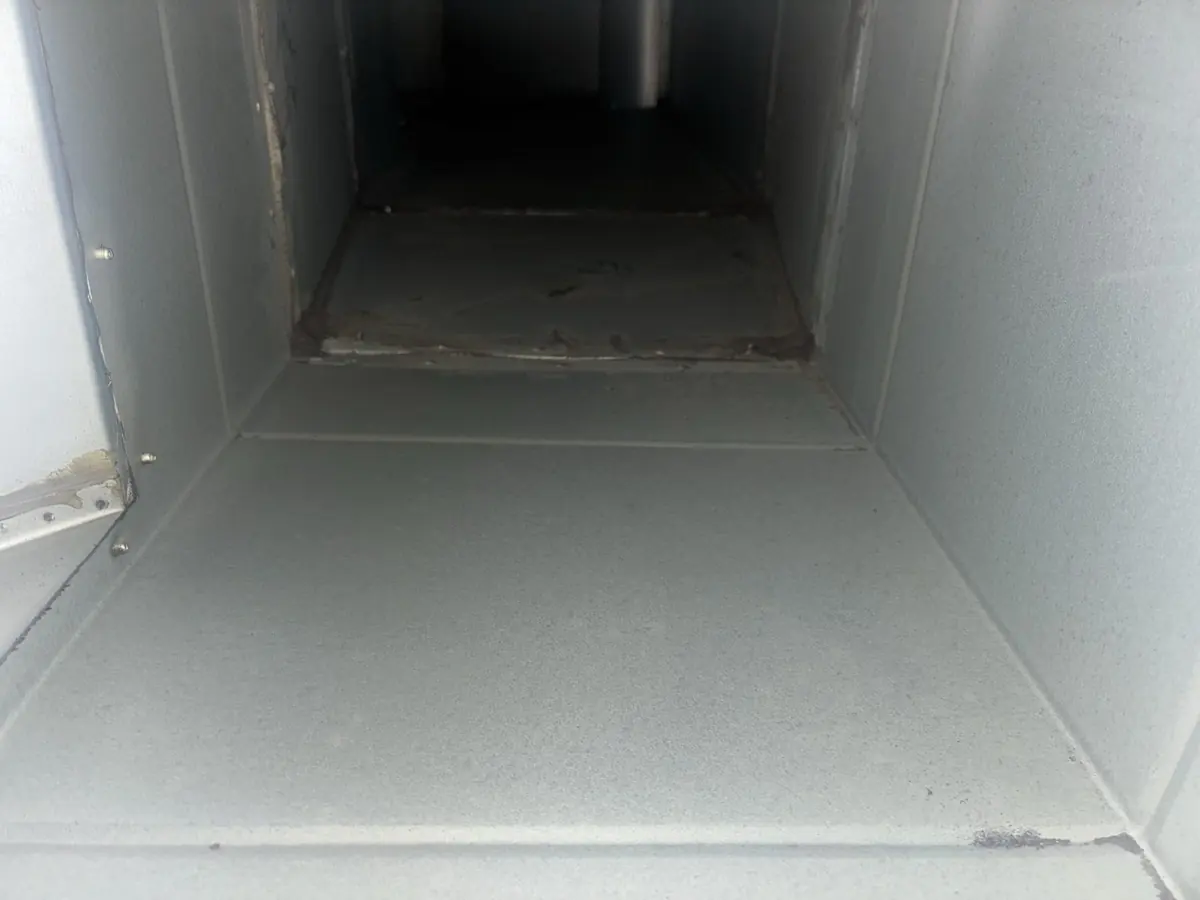
The standard addresses the full extract pathway: canopy and filters, the plenum behind them, the complete ductwork run, and the fan and discharge point. A canopy-only clean does not meet it.
Access provision
Systems need enough access panels to permit inspection and cleaning of the full run. Where access is inadequate, the standard expects that to be recorded and remedied rather than quietly ignored.
Documentation
Pre- and post-clean readings, photographic evidence, a system description, a schematic showing access, and a certificate stating the next clean date.
Who is responsible — landlord or tenant?
Usually whoever holds the fire risk assessment duty under the 2005 Order, which in leased premises is normally the occupying business. But check your lease: many make extract cleaning an explicit tenant obligation, and some make it the landlord's.
Whatever the lease says, your insurer will ask the occupier for the records. Settle it in writing with your landlord if there is any doubt.
What enforcement actually looks like
In practice, very few operators are ever inspected specifically for extract cleanliness. The risk arrives in one of three ways:
1. After a fire, when the loss adjuster asks for records and the claim turns on what you can produce 2. At an EHO inspection, where maintenance records form part of the assessment of management controls 3. At a fire risk assessment, where a competent assessor will ask when the system was last cleaned and to what standard
None of these are routine. All three arrive without warning, and all three are decided on paperwork you either have or do not.
The practical position
You are not required by law to comply with TR19. You *are* required to manage fire risk, ventilate the workplace adequately, and keep the kitchen safe for food production — and TR19 is the recognised method for demonstrating you have done so in relation to grease.
Working to it is the straightforward route to being able to prove compliance. Ignoring it leaves you arguing from first principles at the worst possible moment.
Getting a quote
We arrange TR19-focused kitchen extract cleaning through specialist providers across Pembrokeshire and West Wales, with the readings, photographs and certification described above. Quotes are free and there is no obligation.
Related Service
TR19 Extract Cleaning
Full TR19-focused extract cleaning across Pembrokeshire with post-clean certification at every visit.
Learn more about TR19 Extract CleaningAreas We Cover
We arrange kitchen extract cleaning quotes across all of Pembrokeshire and West Wales: